San Clemente Project in Rome
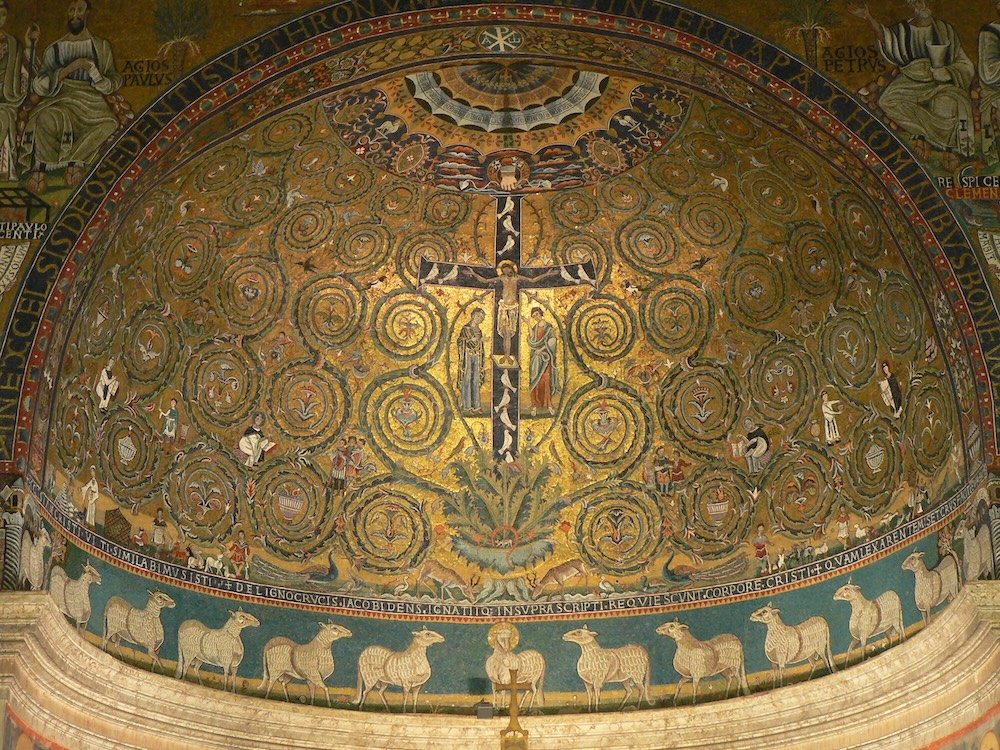
The 800-year-old Basilica of San Clemente in Rome stands as a testament to centuries of faith, art, and perseverance. Layer upon layer of history reveals the devotion of those who came before us — believers who built not only with stone, but with trust in God’s enduring presence.
As we admire its beauty and the devotion that shaped it, we must ask ourselves: What legacy will we leave for future generations?
The San Clemente Project is a historic project that seeks to safeguard the Basilica’s treasures for future generations and to ensure that every visitor leaves not just a tourist, but a pilgrim renewed in faith. This restoration is bringing the Church’s artistic heritage to life as a modern instrument of evangelization, preserving the past to inspire the future.
Learn more via the video below or visit their website here. Additionally, you can contact parish staff member Lara Engert.
There are deep connections between the Basilica of San Clemente in Rome and our own Saint Clement Parish. Our parishioner Jim Perry recently shared his reflections on these connections in a speech at the 2026 Anchor Ball. We invite you to read his speech further down on the page.
From Rome to Lincoln Park:
Connecting Our Parish to Its Namesake
The rich history of San Clemente in Rome isn’t just an artifact of the past — it lives on in our own Saint Clement Parish.
At the recent Anchor Ball (parish fundraiser), honoree Jim Perry shared reflections on the deep connections between the Basilica of San Clemente in Rome and our own parish. His speech highlights the spiritual and artistic legacy that links our community to centuries of faith, and reminds us of the living, vibrant church we are part of today. We are happy to share Jim’s speech below:
2026 Anchor Ball Speech by Jim Perry (on behalf of himself and his wife Molly Perry)
A Parish That Shapes Lives
Saint Clement, this faith community, this church. When you force yourself to take stock, to reflect for something like this award, the realization kind of dawns on you. Saint Clement has been the cornerstone of our lives, the life Molly and I have built together.
It's probably true for many of you. There is something very special about Saint Clement, isn't there, and there's something deeply mystical, I believe, about Saint Clement Church too.
I walked through the doors of Saint Clement for the first time in the fall of 1985, having just moved up from the Gold Coast, three years out of college. I was of course clueless about how deeply woven Saint Clement would become in my life ahead.
There was a lot going on back then, just as there is now. The school was struggling to get by. The Lincoln Park Community Shelter was about to born. The church was being renovated, redesigned really, a source of much disputation.
That's in part what made Saint Clement always interesting--disputation. There were arguments about everything. I remember once in the late 80s or early 90s mustering the courage in a crowded gathering in Fahey to stand up and make the argument that, no, JC was a real historical person who was credibly resurrected, not a mythic figure invented by the early Church, as our discussion leader was arguing--and who just happened to be one of our priests! That was probably a first. He left the priesthood not long after, no surprise!. A parish community wrestling with faith, many fumbling like me to make sense of what it means to be Catholic in the modern world, what it means to grow deeper in faith and relationship with Christ.
Molly and I met there--on a stewardship committee she naively thought was about welcoming, not fundraising. We made many friends there, baptized two of our three there, sent our kids through school there. Maybe the biggest surprise of all was that one of our three would become a Saint Clement teacher.
I remember like yesterday, walking Kate to the school's front steps for her very first time, on her first day of pre-school, she marching bravely at first, three-quarters backpack, and then stopping in her tracks at the foot of the first step, bursting into uncontrollable tears, deaf to any coaxing, her feet anchored as if in cement, until finally plucked and carried away inside the school by a consoling teacher. Perhaps she had a vision of the Saint Clement fourth grade teacher she would become...and having to deal with all the crazy parents? Kate, your hard work and indefatigable commitment to teaching has made your mom and I so proud.
And let me tell you, if there's one thing we've learned, and kind of feel guilty about for not appreciating a long time ago, no one, nobody works harder, cares more than a Catholic elementary school teacher! Thanks for all you do, teachers of Saint Clement!
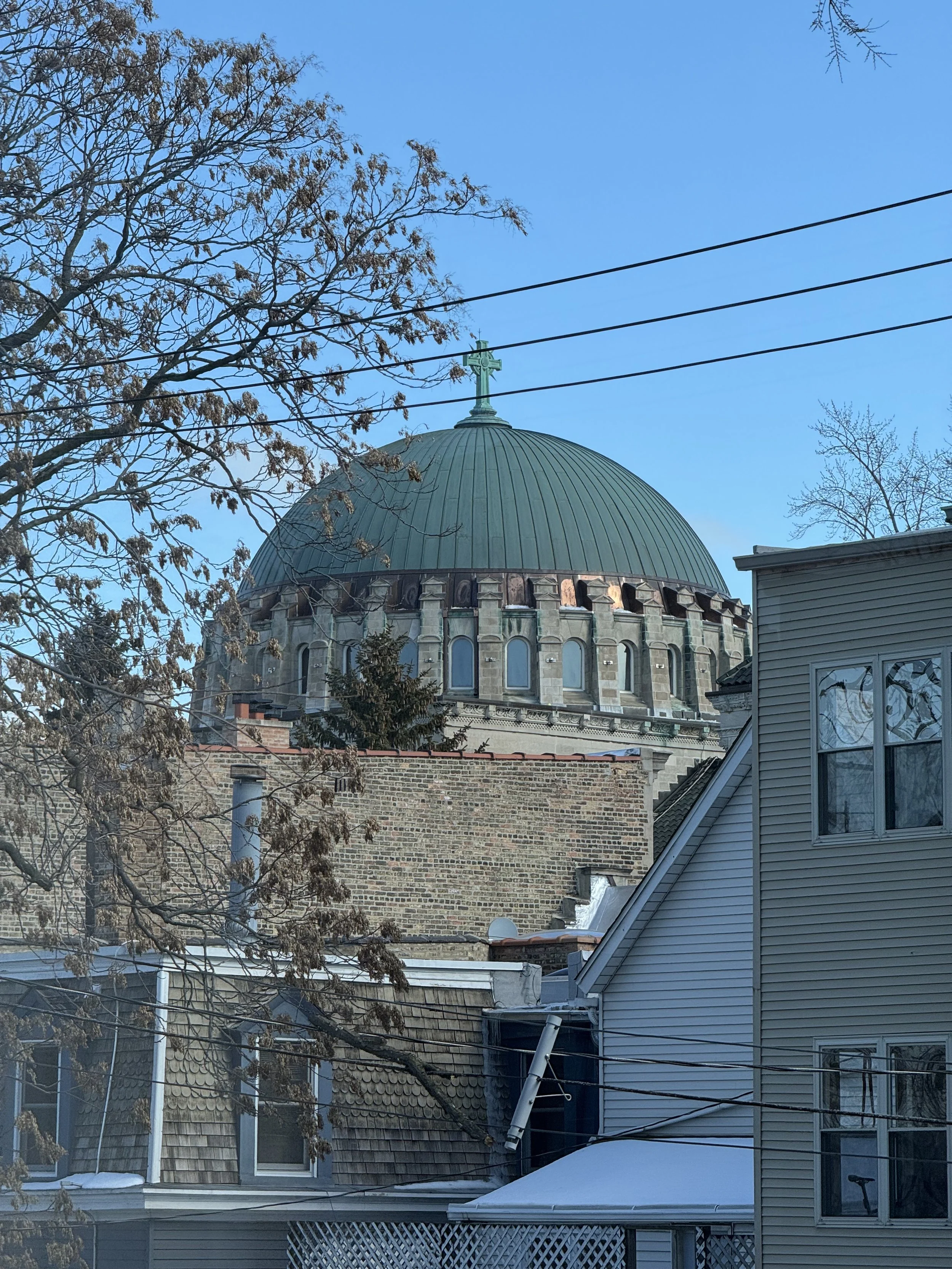
Dome of Saint Clement Parish
The Tree of Life: Rome to Chicago
Parish community, school community, faith community, yes, but there's something about the place too, the church itself. There's an incredible beauty within it, sure. But there's something more about it. It's like a living thing. We see it every morning from our bedroom window, the hulk of its great dome brooding over the neighborhood, the regular chiming from its bell tower, calling, calling...What is it about this place, this building, this church?
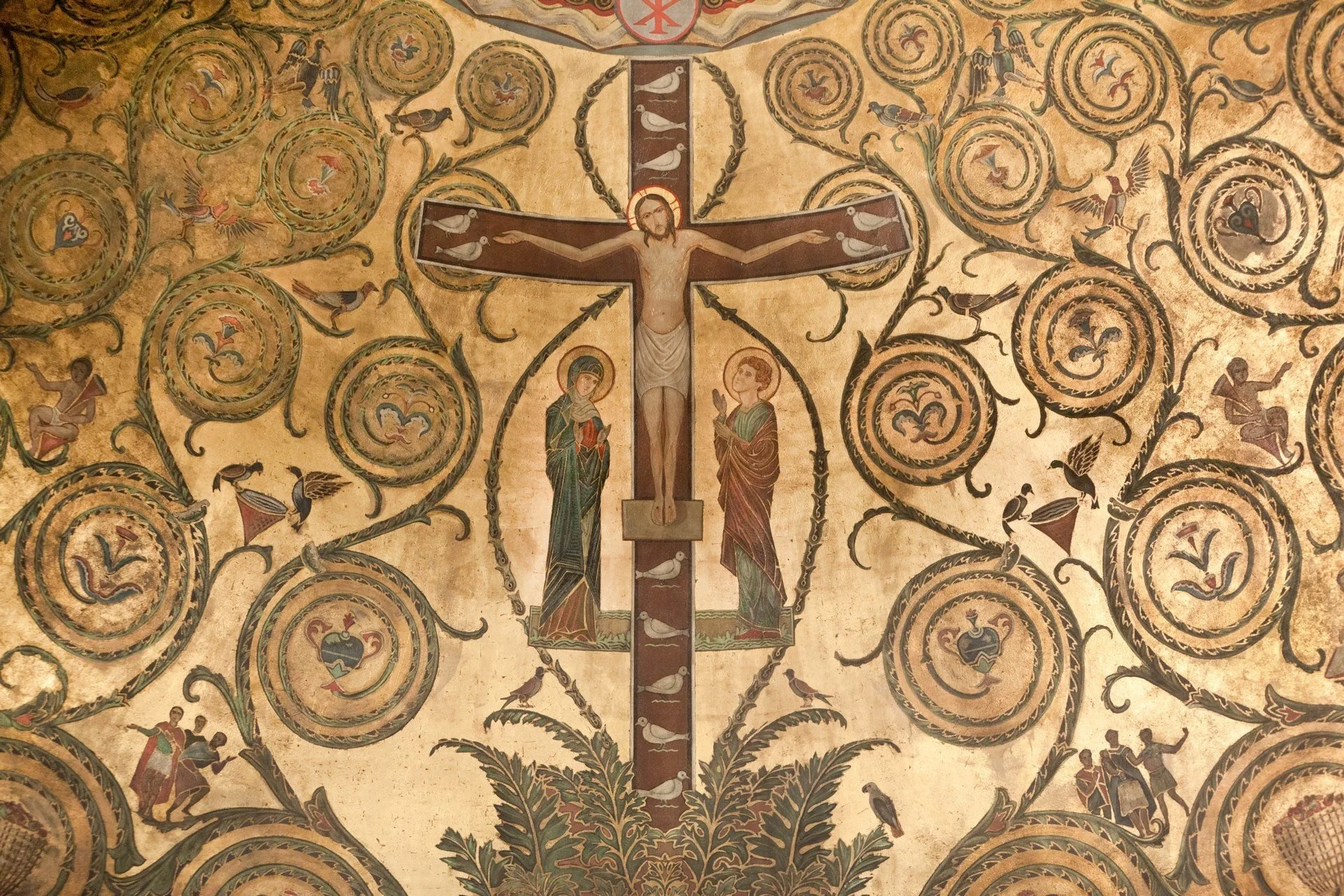
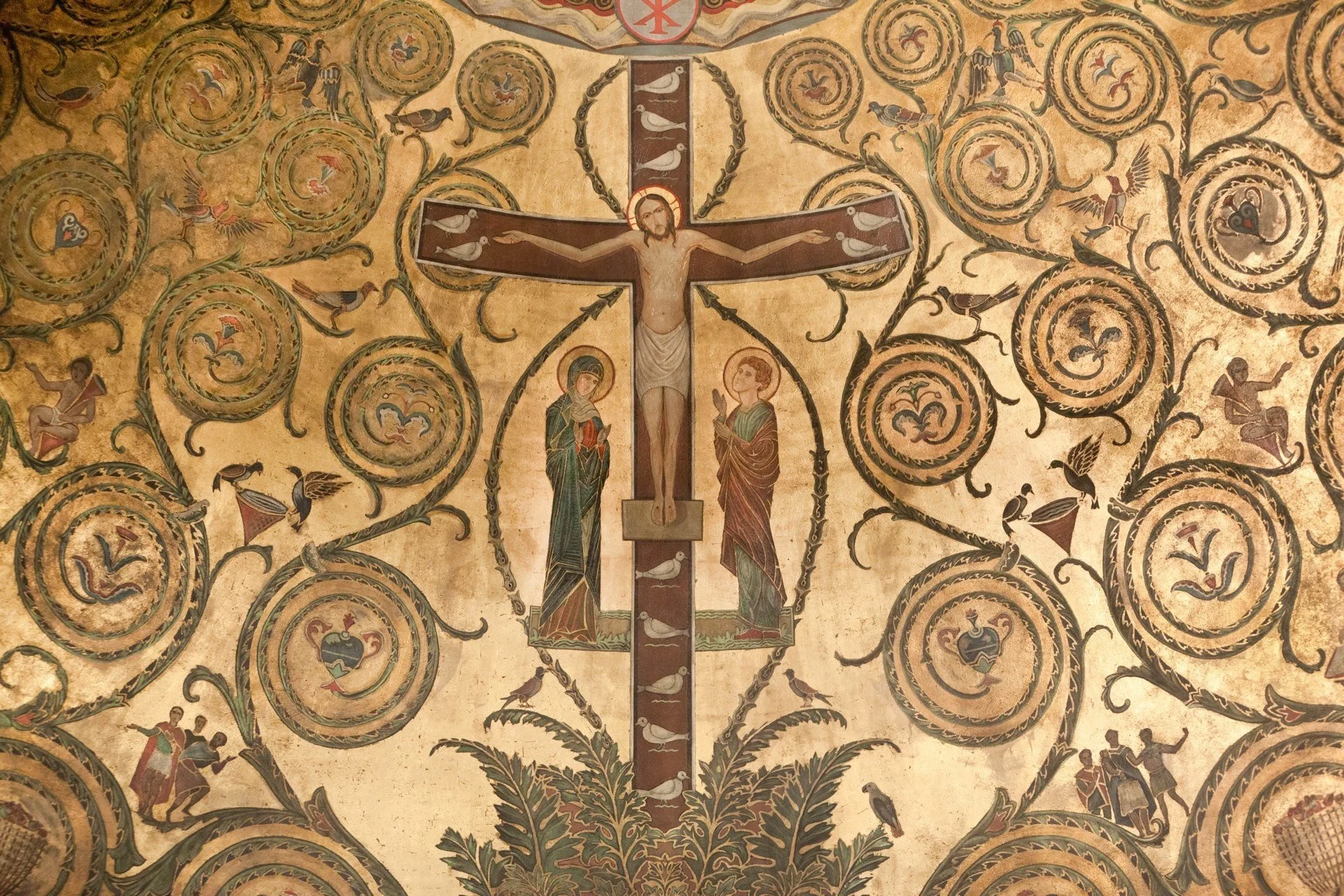
The beginning of the answer is in that tree of life looming above the altar in its apse (pictured below left). Many of you know by now that this tree of life is a painted replica of the great 12th century stone mosaic in the apse (pictured below right) of our namesake, our patrimony, Basilica San Clemente in Rome, a layer cake of churches that descends down through the centuries to the first century sidewalks of Rome.
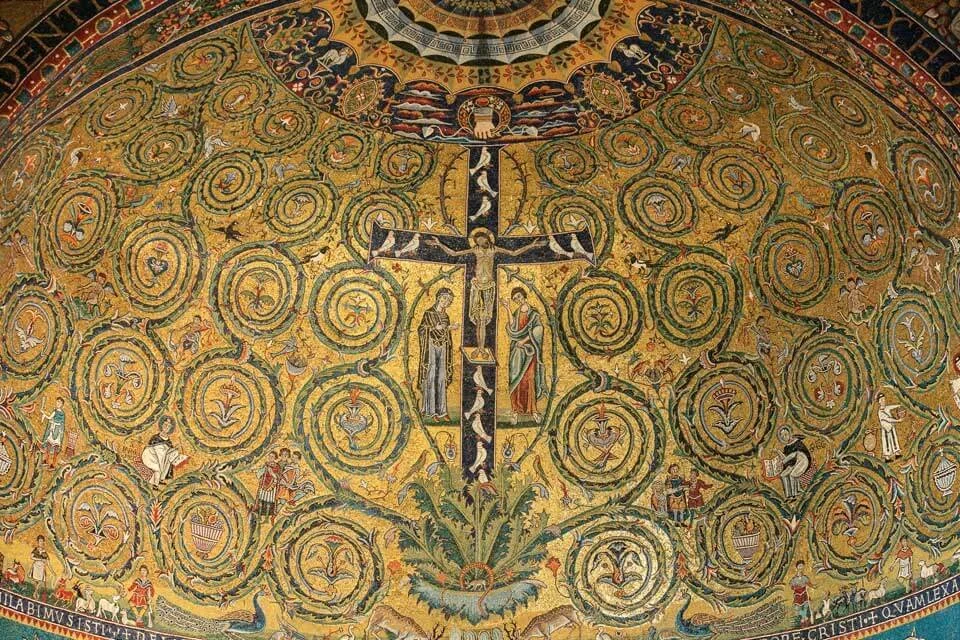
At the bottom of the basilica are the remains of an ancient villa. The latest scholarship on San Clemente posits that the villa was likely built in the first century by Titus Flavius Clemens, a Roman consul who was executed around the year 95 by the Roman emperor Domitian, his first cousin, for being an "atheist," code word for Christian then.
Sometime in the late third century a house church was built within the walls of that villa that took the name San Clemente. We know that St Clement was first a slave, and we know that slaves in those times often took the name of the home they served. Clement was the bishop of Rome, sometime btw the 70s and 90s, so it's quite possible that the basilica of San Clemente, the basilica named for St Clement, Clement the third successor to Peter, some scholars believe the first successor to St Peter, was where St Clement himself once lived and served. St Clement, who knew many of the apostles, including St Peter, who, of course, knew Jesus Christ.
The discovery of the early churches and many frescoes and works of art beneath the 12th century basilica unfolded during the late 1800s, and they were a source of inspiration for the founders of our own Saint Clement. The discoveries were quite the rage in archeological and theological circles during those years, evidence for many that those stories and speculations about the early Church were really true.
Our founders saw then what one sees now standing before the altar and below that mosaic in San Clemente. The cross (pictured below left) thrust by the hand of God like a sword into the earth. A sword that slew the world and all it formerly stood for. And from that cross water and life and vines spring and uncoil and spill out over the altar, down the main aisle of the basilica and through its doors out into the world (pictured below right).
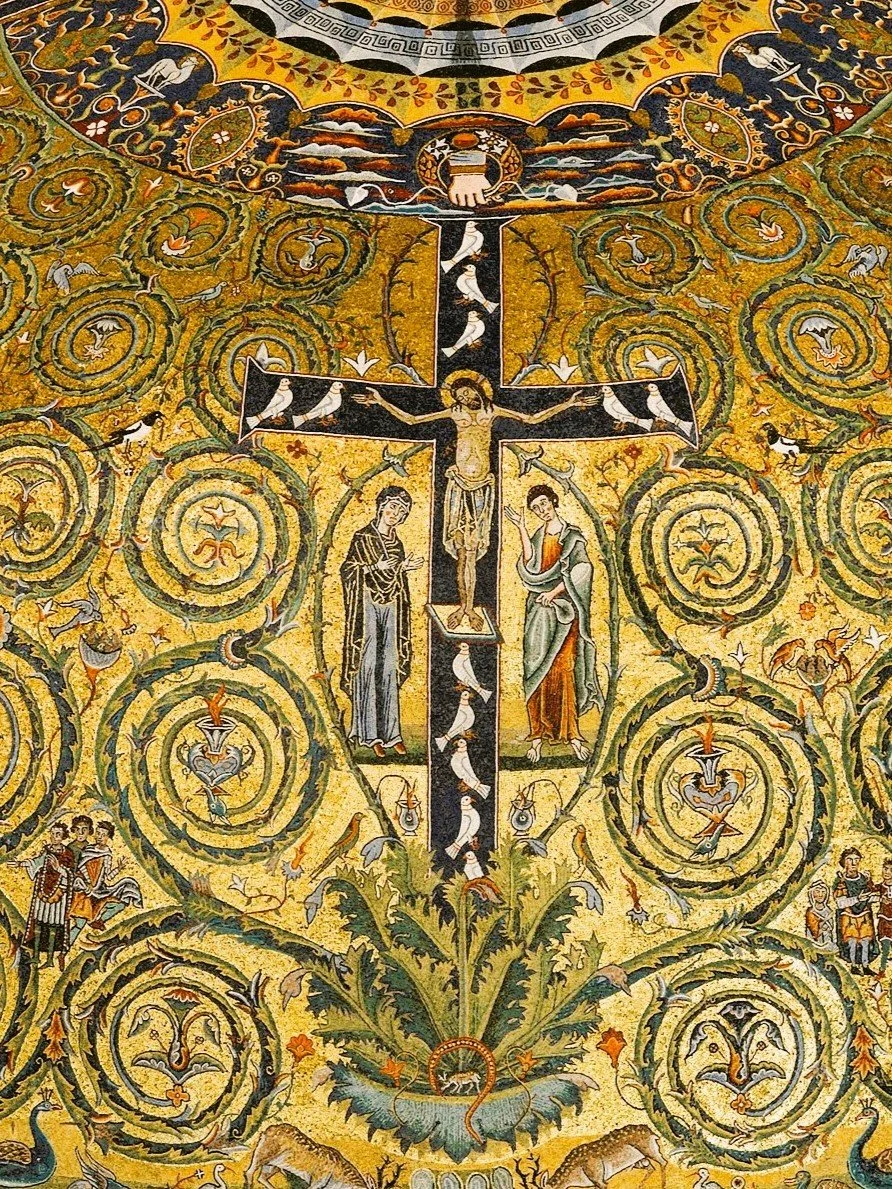
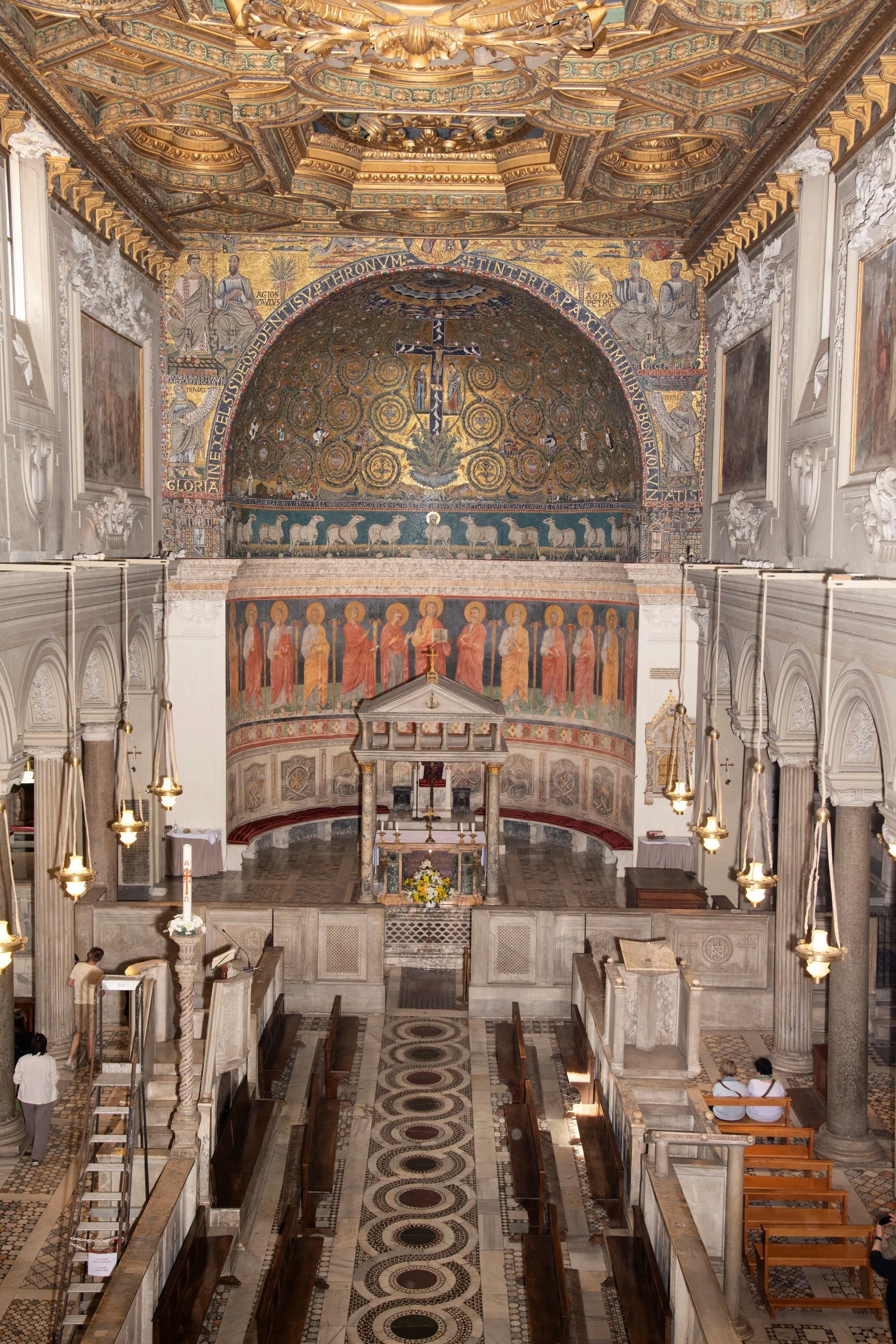
From that tree and from those vines our own tree of life descends, our church rooted in that basilica, rooted in the men and women who dedicated their lives centuries ago to building the universal church. We are all in a very mystical and yet very real sense of the same vine as St Clement, Peter and Paul.
Saint Clement is a living church. It is a mystical place. It's tendrils tug at us, draw us into a vine that emanates from the very beginning of the Catholic Church, from the outstretched hands on that wooden cross, in through our families, through this parish, this school, our very own church of Saint Clement.